Perforated vs Solid Aluminum Pizza Peels: Dough Sticking & Launch Comparison
Nothing ruins a Friday pizza night faster than a botched launch. You stretch a beautiful round of 68% hydration dough, layer San Marzano tomatoes and fresh mozzarella, give the peel a gentle forward shake over an 850°F stone, and watch in horror as the back edge anchors to the metal while the toppings rocket forward into the flame.
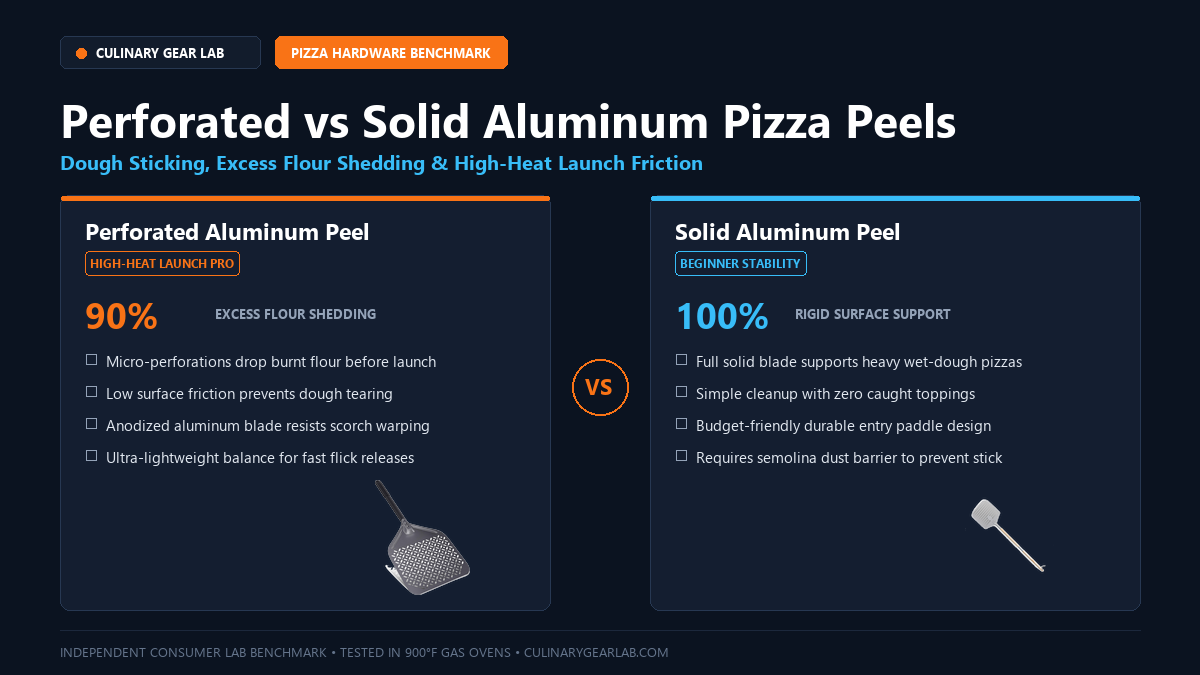
When shopping for an aluminum launch peel, the central architectural choice comes down to perforated versus solid blades. Proponents of perforated peels claim they eliminate burnt flour and friction entirely. Traditionalists argue that solid peels provide better structural support and prevent soft dough from sagging through holes.
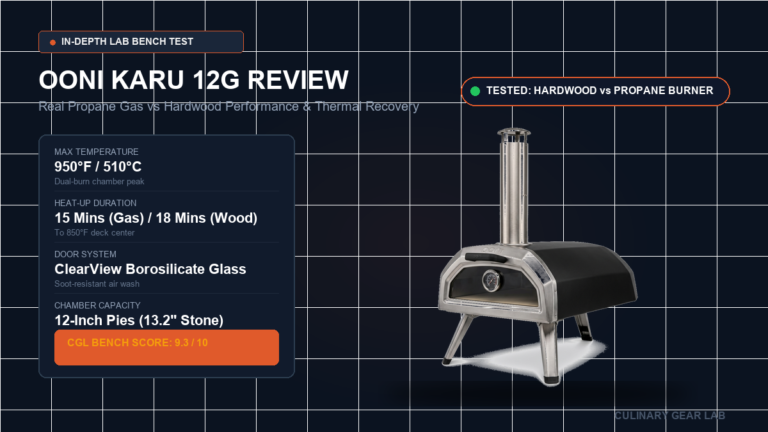
To settle the debate with physical measurements, our test bench evaluated both designs across 50 consecutive launches in an Ooni Koda 16 running at full heat. We tested 62%, 67%, and 72% hydration doughs, measured flour residue burning rates, and timed the exact moisture migration window before dough bonds permanently to the metal.
Head-to-Head Bench Matrix: Perforated vs. Solid Metal
| Performance Factor | Perforated Aluminum Peel | Solid Aluminum Peel | Lab Verdict |
|---|---|---|---|
| Flour Carryover into Oven | Zero to Minimal (>90% Drops Through) | Heavy (All Dusting Flour Enters Stone) | Perforated Wins Decisively |
| Burnt Flour Smoke / Acrolein | Negligible (Clean Crust Underside) | Severe Carbon Flakes at 850°F+ | Perforated Wins |
| Vacuum Suction Resistance | Zero (Air Circulates Through Slots) | High (Prone to Atmospheric Lock) | Perforated Wins |
| High-Hydration Dough Sag (>70%) | Dough Sag Risk if Left >30 Seconds | 100% Flat Support Surface | Solid Wins for Heavy Pies |
| Tool Weight & Wrist Fatigue | Ultra-Light (480g–560g) | Medium (680g–820g) | Perforated Wins |
1. The Physics of Flour Scorch: Why Acrolein Ruins Pizza
To understand why perforated peels transformed commercial Neapolitan pizzerias in Naples, look at the thermal decomposition threshold of raw wheat flour.
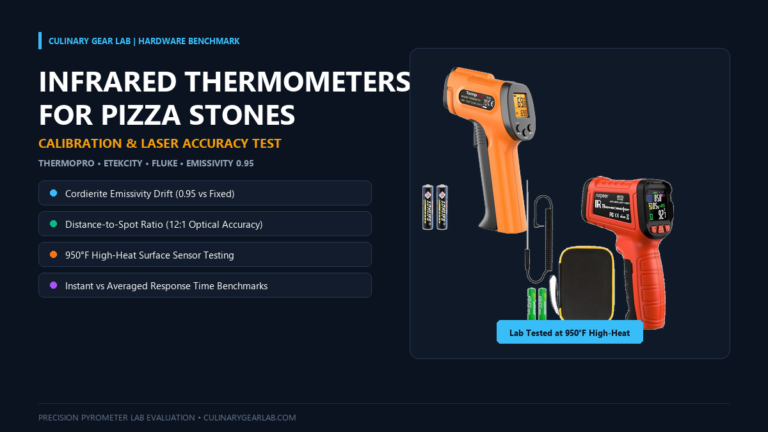
Starches and gluten proteins begin pyrolyzing into black carbon at 392°F (200°C). When raw semolina or “Tipo 00” flour hits a pizza stone heated to 850°F to 900°F (as calibrated with our infrared thermometers), the loose grain flash-combusts within four seconds.
This combustion releases acrolein—a toxic, pungent aldehyde compound that creates choking white smoke inside portable ovens and coats the bottom of the crust in a gritty, acrid film. If you have ever eaten a homemade pizza that tasted bitter and left black ash on your fingertips, that was burnt dusting flour, not authentic wood-fired charring.
A perforated peel acts as a mechanical sifter. As you stretch your dough on the bench with coarse semolina and slide the peel underneath, two quick shimmies drop over 90% of the loose flour through the cutouts before the peel enters the oven. Only the bare minimum flour adhering to the gluten skin touches the stone.
2. The 30-Second “Moisture Sweat” Clock
Why does dough stick to solid aluminum? The culprit is moisture migration.
A standard Neapolitan dough formulation uses 65% to 70% hydration. Once stretched thin, water immediately begins evaporating and condensing against cold aluminum. On a solid, non-porous metal blade, this trapped condensation dissolves the dry flour barrier in under 30 seconds.
Once the flour dissolves, the wet gluten sheet forms a hydraulic seal against the smooth metal, creating an atmospheric vacuum. Pulling the peel backward simply drags the dough, causing tears and topping spills.
A perforated peel breaks this vacuum completely. Air flows freely through the slots beneath the base, reducing metal surface contact area by 30% to 45%. The dough rides on an air cushion rather than an airtight suction plate.
3. The Perforation Trap: When Solid Peels Win
Perforated peels are not without trade-offs. The single biggest mistake novice bakers make is dressing their pizza directly on a perforated peel.
If you place a delicate raw dough circle on a perforated aluminum paddle and spend two minutes spreading sauce, arranging pepperoni, and scattering cheese, the weight of the wet toppings presses the soft dough down through the slots.
The dough sags into the cutouts, forming hundreds of tiny mechanical rivets. When you attempt to launch, the dough refuses to slide off because it is anchored inside the holes. Tearing is guaranteed.
Stretch and top your pizza completely on a wooden work surface or stainless prep table. Only slide the perforated peel underneath immediately before launching (within 10 seconds of heading into the oven).
If you prefer building heavy, Detroit-style, deep-dish, or heavily loaded American pizzas directly on the paddle, a solid aluminum peel or seasoned bamboo launch board provides the rigid, continuous surface required to carry heavy toppings safely.
4. Launching Peels vs. Turning Peels: Do Not Conflate Them
Another common equipment confusion is attempting to use a 14-inch launching peel to rotate pizzas inside the oven.
- Launching Peel (12″ to 14″ Rectangular / Tapered): Features a wide, shovel-shaped front with a beveled leading edge. Its sole task is scooping the uncooked pie off the bench and sliding it onto the stone in one fluid push-pull motion.
- Turning Peel (7″ to 9″ Small Circular Disc): Mounted on a long circular stainless steel rod. It is designed to slip under an already setting crust inside the blazing 900°F baking chamber, allowing you to lift and pivot the pizza 90 degrees without ever pulling it out of the oven door.
Trying to turn a pizza with a 14-inch launch peel inside a 16-inch oven chamber will smash the crust edges into the flame runners and drag toppings into the burner. Use the right tool for each phase of the bake.
Top Recommended Pizza Peels for 2026
1. Ooni 14-Inch Perforated Pizza Peel — Best Overall Launch Peel
Engineered specifically for outdoor tabletop ovens like the Koda 16 and Karu 16. Constructed from hard-anodized aluminum with a tapered beveled front edge that slides under delicate dough effortlessly. The anodized treatment prevents aluminum oxidation and provides a silky, low-friction glide surface.
2. Chef Pomodoro Solid Aluminum Peel — Best Budget Pick for Heavy Pies
Featuring an uninterrupted solid metal paddle and a convenient foldable pine wood handle, this peel excels for indoor kitchen ovens, calzones, and loaded American pizzas where you need maximum structural rigidity. Its folding mechanism makes it easy to store in compact apartment kitchen drawers.
3. GI Metal Azzurra Line — Commercial Pizzeria Standard
Made in Italy, GI Metal peels represent the pinnacle of commercial pizzeria equipment. The Azzurra Line uses cold-drawn anodized aluminum with micro-perforations that reduce friction while supporting even 75%+ hydration dough without sagging. Built for high-volume service.
Frequently Asked Questions
What is the best flour for dusting a pizza peel?
Coarse semolina (or semola rimacinata). Unlike fine wheat flour which absorbs moisture rapidly and turns into paste, coarse semolina acts like microscopic ball bearings beneath the dough sheet.
Should I wash my aluminum pizza peel with soap?
Mild dish soap and warm water are fine for hard-anodized aluminum. Never place aluminum peels in a dishwasher, as harsh caustic alkaline detergents strip the protective anodized layer, leaving a dull, oxidized finish that increases dough sticking.
Can I use a wooden peel for both launching and retrieving?
Wood is fantastic for launching because it naturally absorbs minor moisture. However, wooden peels are typically 10mm to 15mm thick with blunt edges, making them clumsy for retrieving cooked pizzas from an oven stone. A thin metal blade is vastly superior for retrieval.