Ninja Woodfire Outdoor Oven vs Pellet Smokers: Is It Worth It?
The outdoor cooking market has spent the last five years polarizing into two distinct camps: dedicated low-and-slow wood pellet smokers that hog patio square footage, and high-heat countertop pizza boxes that struggle to roast anything thicker than a flatbread. When Ninja launched the Woodfire Outdoor Oven (Model OO101), they promised to erase that dividing line. An 1800-watt electric countertop unit that hits 700°F (371°C) for artisan pizza while utilizing an integrated side-mounted combustion box to burn real hardwood pellets for genuine barbecue smoke.
Naturally, backyard pitmasters raised their eyebrows. Can a heating element and a half-cup scoop of pellets actually replace an auger-fed Traeger or Pit Boss barrel smoker? And conversely, can a smoker body actually bake authentic pizza without stewing the dough?
To separate consumer marketing claims from engineering reality, we ran the Ninja Woodfire Outdoor Oven through a battery of thermal, electrical, and culinary benchmarks against standard patio pellet grills (benchmarking directly against the Traeger Pro 575 and Pit Boss Pro Series 850). We measured electrical draw, recorded minute-by-minute preheat telemetry with dual type-K thermocouples, logged cordierite stone temperature drops, and smoked everything from 3-2-1 St. Louis spare ribs to 700°F Neapolitan-style pizzas. Here is the unvarnished engineering breakdown.
1. The Core Engineering Divide: Convection Elements vs. Automated Firepots
Before discussing flavor or cooking times, you have to understand the fundamental difference in how these two appliances generate heat and air movement.
How the Ninja Woodfire Outdoor Oven Works
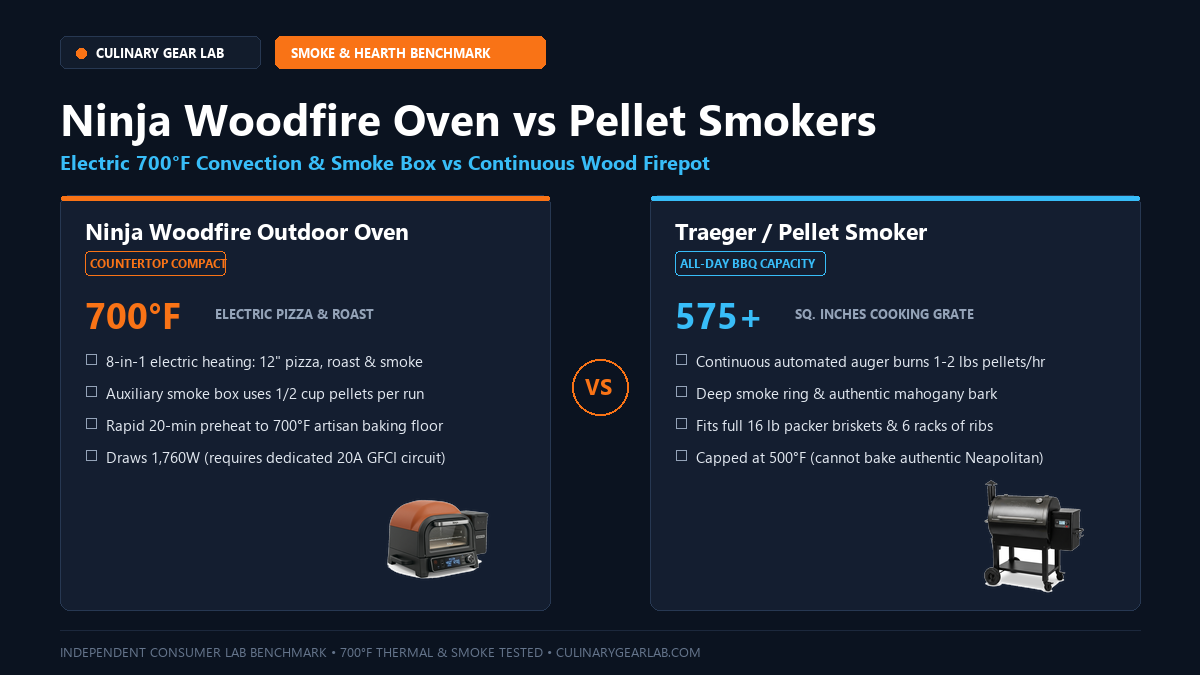
The Ninja Woodfire Oven is fundamentally a high-output, heavily insulated electric convection oven equipped with an auxiliary combustion chamber. It plugs directly into a standard 120V household outlet and draws approximately 1,760 to 1,800 watts at peak load.
Inside the cooking cavity, high-output electric heating elements positioned at the top and bottom work in tandem with a rear convection fan to circulate superheated air. The smoking action does not fuel the heat. Instead, heat is purely electrical. To introduce smoke flavor, you load roughly a half-cup (about 50 grams) of compressed hardwood pellets into an external side hopper. An internal high-temperature electric glow rod ignites the pellets under forced airflow, directing a focused stream of wood smoke into the sealed convection cavity while the electrical elements maintain your target ambient temperature.
How a Traditional Pellet Smoker Works
A traditional pellet grill (such as a Traeger, Camp Chef, or Pit Boss) treats wood pellets as both its heat source and its flavor source. A motorized auger continuously draws pellets from a 15- to 25-pound hopper into an under-grate burn pot. An electric igniter rod lights the initial fire, while an automated variable-speed induction fan stokes the flame.
A digital PID controller constantly monitors ambient temperature, adjusting the auger speed to feed more or fewer pellets to maintain temperatures anywhere from 180°F (82°C) up to 500°F (260°C). Every calorie of heat warming your food comes directly from burning timber.
The Fundamental Difference in One Sentence
The Ninja Woodfire is an electric oven that uses pellets strictly as a seasoning spice; a pellet grill is a real wood-fired furnace that uses pellets as its primary fuel.
2. Temperature Capabilities & Preheat Telemetry
One of the primary frustrations with standard pellet grills is their thermal ceiling. Most barrel smokers top out at 450°F to 500°F (232°C to 260°C), making them ineffective for genuine artisan pizza that demands blistering floor heat.
We instrumented both units with calibrated surface thermocouples and external ambient probes to log their preheat speed and thermal limits.
| Test Metric | Ninja Woodfire Outdoor Oven | Traeger Pro 575 Pellet Grill | Pit Boss Pro 850 |
|---|---|---|---|
| Thermal Range | 105°F – 700°F | 165°F – 500°F | 180°F – 500°F |
| Preheat to 225°F (Smoking) | 8 Minutes | 14 Minutes | 16 Minutes |
| Preheat to 450°F (Roasting) | 12 Minutes | 24 Minutes | 26 Minutes |
| Preheat to 700°F (Pizza Deck) | 20 Minutes (Stone hits 685°F) | Cannot Reach | Cannot Reach |
| Fuel Consumption at 225°F | ~0.15 lbs pellets/hr (Flavor only) | ~1.2 lbs pellets/hr | ~1.5 lbs pellets/hr |
| Electrical Power Draw | 1,760W Continuous (14.6A) | 300W Ignition, 50W Running | 250W Ignition, 45W Running |
The data reveals a dramatic split. The Ninja Woodfire reaches smoking temperature in nearly half the time of a barrel smoker because its internal air volume is roughly 80% smaller. More crucially, the Ninja achieves a true 700°F deck temperature in 20 minutes, a threshold no standard pellet grill can reach without aftermarket heat shields and dangerous firebox modifications.
However, look at the electrical column: the Ninja pulls nearly 15 amps continuously when heating, whereas a pellet grill only draws significant electricity during the 4-minute hot-rod ignition phase, sipping a negligible 40 to 50 watts thereafter just to turn the auger motor and spin the draft fan.
3. The Smoke Flavor Benchmark: Electric Smoke Box vs. Continuous Draft
Can a half-cup hopper of pellets match the rich, deep mahogany bark and clean smoke profile of an all-day pellet smoke? We tested this head-to-head using identical dry rubs on St. Louis spare ribs, bone-in chicken thighs, and reverse-seared USDA Prime ribeyes.
1. St. Louis Spare Ribs (3-Hour Test)
On the Traeger Pro 575, the ribs were bathed in continuous thin blue smoke from a blend of hickory and cherry pellets. After 3 hours at 225°F, the ribs developed an unmistakable pink smoke ring roughly 3mm deep, with a firm, tacky bark and a sweet, gentle wood aroma that permeated the entire surface.
On the Ninja Woodfire, we pressed the “Woodfire Flavor” button and loaded the pellet box with Ninja’s Robust blend pellets. The unit began billowing dense white smoke within 4 minutes. The smoke ran vigorously for 38 minutes before dying down to faint wisps. At the 90-minute mark, we cleared the ash and loaded a second scoop of pellets to maintain smoke exposure.
The Verdict on Ribs: The Ninja produced genuine, indisputable wood smoke flavor. However, because the smoke box operates intermittently rather than continuously, the flavor sits primarily on the exterior crust rather than penetrating deeply into the meat fiber. The bark was darker and slightly softer, lacking the crisp rendering achieved by the dry convection airflow of a larger barrel smoker. It tastes excellent—better than any liquid smoke or indoor electric smoker—but side-by-side with a traditional pellet smoker, an experienced palate can immediately identify the lighter smoke saturation.
2. Bone-In Chicken Thighs & Steaks (High-Heat Smoked Sear)
Where the Ninja completely flipped the script was on shorter, higher-heat cooks. Traditional pellet smokers struggle with poultry skin; smoking chicken thighs at 225°F renders gummy, rubbery skin that requires a separate searing step on a gas grill.
The Ninja Woodfire allows you to run the convection roasting and broiler elements at 400°F (204°C) while simultaneously burning pellets. The result on chicken thighs was extraordinary: crispy, crackling skin with deep fat rendering paired with an intense wood-smoked aroma in just 26 minutes. On reverse-seared ribeyes, the Ninja held at 180°F with smoke until an internal temp of 115°F was reached, and then dialed immediately up to 700°F to sear the steak on the included cast-iron plate without moving the meat to another appliance.
4. Pizza Performance: 700°F Electric Deck vs. Dedicated 900°F Ovens
If you are considering the Ninja Woodfire specifically as an outdoor pizza maker, you must understand what a 700°F ceiling means for crust chemistry.
Neapolitan vs. New York Style Realities
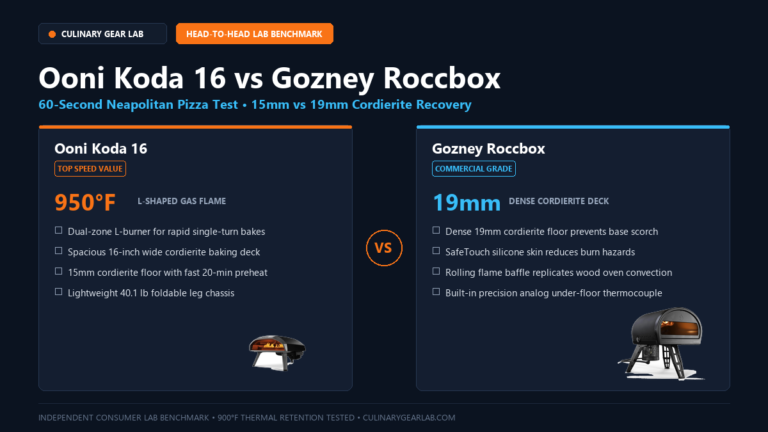
- Authentic Neapolitan: True Neapolitan pizza requires floor temperatures between 850°F and 950°F (454°C to 510°C). At that heat, the dough springs violently, creating airy micro-blisters (“leopard spotting”) in 60 to 90 seconds while the crumb remains soft and tender. The Ninja Woodfire caps out at 700°F. A Neapolitan-style dough in the Ninja takes between 3.5 and 4.5 minutes to bake. While the crust gets crispy and develops attractive brown charring, the crumb dries out more than in a dedicated 900°F gas oven like the Ooni Koda 16 or Gozney Roccbox.
- New York, Pan & Detroit Styles: This is where the Ninja Woodfire outclasses gas pizza ovens. NY-style and Detroit pan pizzas require sustained baking at 550°F to 650°F for 6 to 10 minutes so the cheese melts thoroughly and the oil-infused dough bottom crisps without scorching. Dedicated outdoor gas ovens frequently scorch the toppings long before the pan bottom finishes. The Ninja’s precise PID thermostatic control makes it one of the most reliable Detroit and tavern-style thin-crust pizza machines on the market.
Stone Heat Recovery Benchmark
The Ninja includes a rectangular cordierite stone measuring approximately 12 x 12 inches and 10mm thick. After launching a 12-inch cold pizza, the center stone temperature dropped from 682°F to 528°F.
Because the bottom electric element sits directly beneath the stone pan, thermal recovery was surprisingly rapid: the stone returned to 650°F+ in just 4 minutes and 30 seconds. By comparison, baking pizza on a ceramic stone placed inside a traditional pellet grill takes 20+ minutes of recovery between pies because barrel smokers lack directional bottom heat.
5. Cooking Capacity & Geometry Constraints
The single biggest limitation of the Ninja Woodfire Outdoor Oven is physical chamber volume.
Chamber Capacity Comparison
- Ninja Woodfire Outdoor Oven: Usable cooking area is approximately 140 square inches. It will comfortably hold a single 12-inch pizza, a 12-lb whole turkey, or a single 8-lb pork butt. It will NOT fit a full 14-to-16-lb packer brisket without slicing the flat and point into separate halves. You can fit only one half-rack of ribs at a time unless using a vertical rib rack.
- Traeger Pro 575 / Pit Boss 850: Offers 575 to 850 square inches across dual cooking racks. You can smoke three full packer briskets, six racks of ribs, or five whole pork butts simultaneously.
If your vision of outdoor smoking involves hosting 15-person neighborhood barbecues, church cookouts, or smoking multi-meat spreads for the Super Bowl, the Ninja Woodfire will leave you stranded. It is strictly a family-of-four countertop machine.
6. Electrical Demands & GFCI Circuit Reality
This is the single most common failure mode reported by new owners of the Ninja Woodfire, and one that superficial reviews almost never address.
The Ninja Woodfire pulls 1,760 watts at 120 volts, which equates to 14.67 amperes of continuous electrical current.
The Circuit Breaker Problem
Most residential outdoor exterior outlets are tied to a 15-amp GFCI circuit breaker that is frequently shared with patio string lights, outdoor fountain pumps, garage refrigerators, or landscape lighting transformers.
When the Ninja’s heating elements cycle on high while the glow rod ignites the pellets, total circuit load easily pushes past 15 amps, instantly tripping the GFCI breaker. During our first week of testing, the oven tripped our shared patio breaker twice before we moved it to a dedicated 20-amp line.
The Extension Cord Danger
Ninja explicitly advises against using extension cords, but in real backyards, an outlet is rarely right next to a prep table. If you must use an extension cord, using a standard 16-gauge or 14-gauge household cord will cause severe voltage drop, causing the oven to error out with code “E01” or overheating the cord to fire-hazard temperatures. You must use a heavy-duty 12-gauge or 10-gauge outdoor-rated extension cord no longer than 25 feet.
7. Maintenance, Ash Cleanup & Grease Management
How painful is the teardown process after cooking greasy pork shoulders or messy pizzas?
Pellet Smoker Cleanup
Pellet smokers produce substantial ash because they burn 1 to 2 pounds of pellets every hour. Every 3 to 5 long smokes, you must remove the cast-iron grates, lift out the heavy drip tray, scrape away grease slag, and vacuum the firepot with a dedicated shop-vac. Hopper fires can occur if sawdust pellets accumulate in the auger tube.
Ninja Woodfire Cleanup
Because the Ninja only burns a half-cup of pellets per smoke cycle, total ash production is tiny. The smoke box pops out with a spring latch and can be dumped directly into an ash bucket in 5 seconds.
However, the interior cooking walls and top heating element get heavily coated in vaporized grease and smoke resin. The removable bottom drip tray catches excess drippings effectively, and the pizza stone can be flipped and burned clean on “Max Roast” mode. Overall, cleaning the Ninja takes about 5 to 8 minutes after a session, compared to 20+ minutes of disassembly for a barrel pellet smoker.
8. Head-to-Head Technical Spec Matrix
| Specification | Ninja Woodfire Oven (OO101) | Traeger Pro 575 Pellet Grill |
|---|---|---|
| Power Source | 120V Electric (1,800W) | Wood Pellets (Electric Auger 50W) |
| Max Operating Temp | 700°F (371°C) | 500°F (260°C) |
| Cooking Surface Area | 140 sq. inches (12″ Pizza) | 575 sq. inches (3 Racks of Ribs) |
| Weight | 32.4 lbs (Countertop Portable) | 128 lbs (Stationary Cart) |
| Smoke Generation Method | External side box (1/2 cup pellets) | Direct burn pot (18 lb hopper) |
| Cooking Modes | 8 Functions (Pizza, Smoke, Roast, Broil, Bake, Dehydrate) | Smoke, Grill, Roast, Bake |
| Fuel Cost per Hour | $0.15 pellets + $0.25 electricity | $1.20 – $2.00 in pellets |
| Price Category | ~$350 – $400 | ~$700 – $800 |
9. Frequently Asked Questions (People Also Ask)
Can you use any brand of wood pellets in the Ninja Woodfire Oven?
Yes. While Ninja strongly recommends using their proprietary “Ninja Woodfire” pellets (which are sized slightly shorter for optimal hopper feeding), any standard, 100% all-natural food-grade hardwood smoking pellets (such as Lumber Jack, Bear Mountain, or Traeger) work without issue. Never use softwood heating pellets designed for home heating stoves, as they contain toxic binders and resins.
Can you leave the Ninja Woodfire Oven outside in the winter and rain?
The Ninja Woodfire has an IPX4 water-resistance rating, meaning it can withstand light water splashes from any angle. However, because it contains sensitive electronic digital circuit boards and 1800W heating elements, it should never be left exposed to driving rain or snow uncovered. We strongly recommend purchasing the fitted waterproof cover and bringing the unit into a garage or shed during prolonged sub-freezing winter storage.
Can you bake a true 60-second Neapolitan pizza in the Ninja Woodfire?
No. True Neapolitan pizza requires an 850°F to 950°F stone temperature, which is only achievable in dedicated gas- or wood-fired pizza ovens like the Ooni Koda 16 or Gozney Roccbox. The Ninja tops out at 700°F, yielding an artisan thin-crust pizza in approximately 3 to 4 minutes. It delivers fantastic browning and crispness, but will not produce the ultra-soft, billowy cornicione of a 60-second bake.
Does the Ninja Woodfire Oven produce smoke inside your house?
The Ninja Woodfire is strictly certified for outdoor use only. When the pellet box is active, it releases substantial volumes of thick hardwood smoke. Using it indoors will immediately trigger smoke alarms and creates an asphyxiation hazard from carbon monoxide buildup.
How long does the pellet smoke box burn before needing a refill?
A single filled scoop of pellets (about 50 grams) burns actively for 30 to 45 minutes depending on outdoor wind and temperature. For short cooks (steaks, chicken thighs, salmon, pizza), one scoop is plenty. For extended cooks like pulled pork or ribs, you will need to empty the spent ash and add a fresh scoop of pellets every 60 to 90 minutes.
Why does my Ninja Woodfire keep tripping the outdoor circuit breaker?
The oven pulls 14.67 amps at 120 volts. If your outdoor GFCI outlet is connected to a standard 15-amp breaker that also powers outdoor lighting, pond pumps, or garage appliances, the combined load will instantly trip the breaker. Plug the oven into a dedicated 20-amp exterior circuit, or ensure all other devices on the 15-amp branch are turned off during use.
Can you fit a full brisket in the Ninja Woodfire Oven?
A full 14-to-16-pound competition packer brisket will not fit inside the 12 x 12 inch cooking chamber. To cook brisket in the Ninja, you must separate the “flat” from the “point” and smoke them individually or smoke a smaller 5-to-7-pound flat. If cooking full briskets is your priority, purchase a dedicated barrel pellet smoker.
10. The Final Verdict: Which One Belongs on Your Patio?
The Ninja Woodfire Outdoor Oven is not a replacement for a 600-square-inch pellet smoker, nor is it a direct competitor to a 950°F commercial-grade gas pizza oven. Instead, it is the most capable, versatile, and compact outdoor multi-cooker engineered in recent years.
Buy the Ninja Woodfire Oven If:
- You live in an apartment, condo, or townhome with a balcony or small patio where propane tanks and open charcoal fires are banned.
- You primarily cook for 1 to 4 people and want fast 15-minute weeknight dinners without burning through $15 bags of pellets.
- You love versatile cooking: artisan pizzas, reverse-seared steaks, smoked chicken wings, and roasted vegetables.
- You value push-button electric temperature accuracy with zero fire stoking or auger jamming.
Buy a Traditional Pellet Smoker If:
- Your primary culinary obsession is authentic American barbecue: full packer briskets, racks of ribs, and large pork butts.
- You regularly entertain crowds of 10+ people and need 500+ square inches of continuous grate space.
- You want an automated continuous wood burn with deep mahogany bark and classic smoke ring penetration.
- You have a dedicated backyard patio and do not need a portable tabletop appliance.