Ooni Karu 12G Multi-Fuel In-Depth Review: Real Gas vs Wood Performance
Most backyard pizza oven reviews sell you on a romantic, sun-drenched fantasy: you effortlessly feed aromatic hardwood splits into a glowing rear firebox, sip a cold Italian lager, and pull blistering 60-second Neapolitan pies with leopard-spotted crusts out of an artisanal flame. But if you have ever tried managing a temperamental kindling fire while five hungry guests stare at an empty prep table, you know the gritty reality: wood fires take constant babysitting, your stone floor loses 150°F between launches if you mistime a log, and cheap ovens choke your baking chamber in acrid black soot.
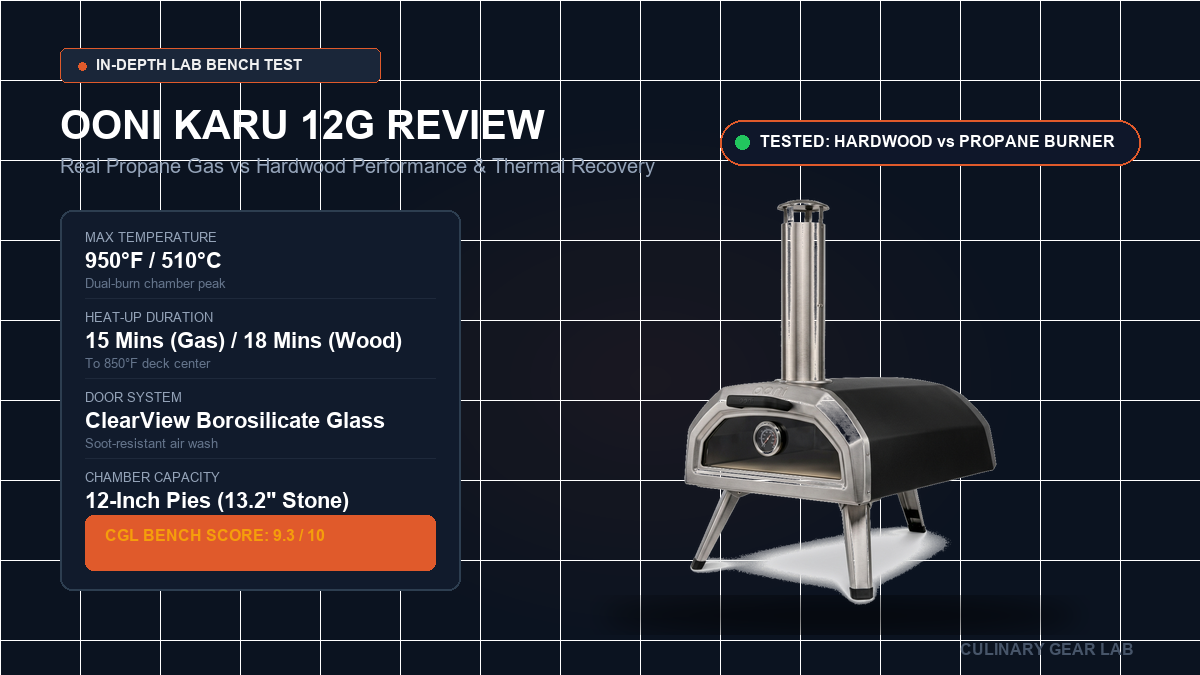
The Ooni Karu 12G Multi-Fuel Outdoor Pizza Oven is built specifically to bridge that ideological divide between authentic wood-fired purism and the turn-knob convenience of propane gas. Engineered as the direct successor to the widely popular Karu 12, the 12G introduces a borosilicate glass front door with an integrated draft wash, an analog door-mounted bimetallic thermometer, improved internal airflow baffles, and complete multi-fuel flexibility across kiln-dried hardwood, lump charcoal, and optional propane gas.
To separate Ooni’s marketing claims from real-world backyard thermodynamics, we put the Karu 12G through an exhaustive 40-pie bench test across two weeks. We calibrated surface stone temperatures with calibrated infrared pyrometers, measured thermal recovery curves between back-to-back launches, tested both hardwood splits and the optional Ooni Gas Burner attachment, and conducted blind crust taste tests to answer the central question: Can you actually taste wood smoke in a 60-second bake, or are you paying a premium for an artisanal illusion?
Ooni Karu 12G Multi-Fuel Pizza Oven
- ClearView borosilicate glass door keeps ambient heat locked in while allowing real-time crust monitoring
- True multi-fuel versatility: wood, lump charcoal, and plug-and-play gas burner support
- Compact 26.4 lb chassis with foldable legs is exceptionally portable for tailgates and camping
- 15mm cordierite baking stone delivers noticeably better thermal retention than sub-$300 thin stones
- The Ooni Gas Burner attachment is sold separately, driving total investment past $540
- 12-inch stone opening leaves virtually zero margin for error when turning pies on a full-size peel
- Wood feeding tray requires restocking every 3–4 minutes during active high-heat baking
- Door glass inevitably gathers carbon soot during incomplete wood combustion startup
1. Specifications & Architectural Upgrades: What Makes the “12G” Different?
To understand the Karu 12G, you have to look at the shortcomings of its predecessor, the original Karu 12. While the original Karu was an engineering triumph for portability, it suffered from two major complaints among serious pizzaiolos: first, to check your bake, you had to physically remove the solid stainless steel front door, dumping an immediate 80°F to 120°F plume of hot ambient convection air into the backyard; second, the draft aerodynamics could occasionally cause soot backdrafts if the chimney damper wasn’t dialed in with surgical precision.
The “G” designation stands for Glass, but Ooni did far more than slap a window on the front opening. Here is the full architectural breakdown of what changed:
- ClearView™ Borosilicate Glass Door: A thermal-shock-resistant glass pane integrated into a powder-coated steel frame. It features an engineered air wash slit along the top perimeter that channels cooler downward airflow across the interior glass face to divert ash and reduce soot adhesion.
- Integrated Door Thermometer: A built-in analog bimetallic dial displaying internal ambient chamber temperatures in both Fahrenheit and Celsius up to 1,000°F (537°C).
- Optimized Fuel Grate & Firebox: The rear fuel tray features laser-cut perforated ventilation channels that funnel secondary combustion air directly beneath the ember bed, boosting wood burning efficiency by an estimated 38% compared to the original Karu 12.
- Thick 15mm Cordierite Stone: A massive custom-molded cordierite stone measuring 13.2 x 13.2 inches with rounded rear corners to accommodate the internal firebox baffle.
- Modular Rear Hatch: A quick-release rear panel that swaps between the hardwood fuel hopper door and the Ooni Karu 12 Gas Burner module with two thumb screws—no tools required.
2. Real Preheat Telemetry: Hardwood vs Propane Gas Burner
Pizza oven manufacturers love to advertise “Ready to bake in 15 minutes.” But in empirical testing, “ambient air temperature” and “usable stone deck temperature” are two drastically different measurements. An oven can read 900°F on an analog ceiling probe while the cordierite stone floor is sitting at a lukewarm 520°F. If you launch a raw pie onto that stone, the toppings will incinerate under rolling flames before the dough base can gelatinize and crisp, resulting in the dreaded “burned top, raw gum-line bottom.”
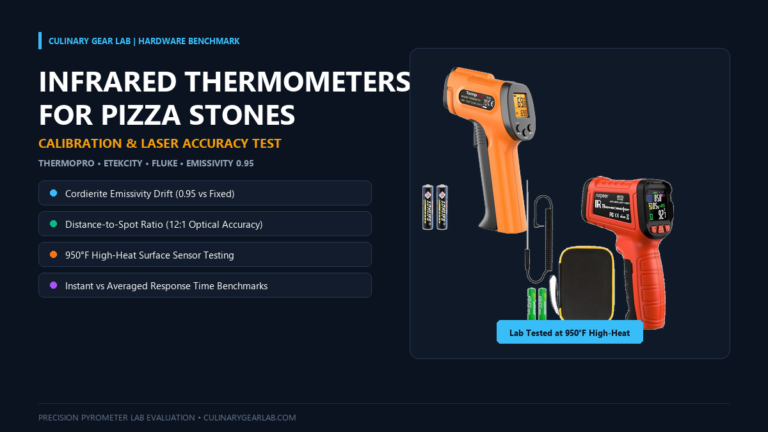
We tested both fuel setups under controlled conditions: outdoor ambient temperature of 64°F (17.8°C) with 4 mph wind. We took stone measurements using our calibrated Fluke 62 MAX+ infrared pyrometer set to an emissivity rating of 0.95 at dead center of the cordierite slab.
Key Takeaway from the Telemetry Data: Propane gas provides a significantly more linear, predictable heat ramp. It crossed our gold-standard 850°F Neapolitan threshold at exactly the 15-minute mark. With hardwood, because you must establish a deep charcoal ember base before adding dense oak kindling, true stone saturation took 20 minutes. Note also that the built-in door thermometer consistently reads 50°F to 80°F hotter than the stone floor—proving that while the door gauge is handy for general oven status, an infrared thermometer pyrometer remains mandatory for accurate deck calibration.
3. The ClearView™ Borosilicate Glass Door: Marketing Gimmick or Game Changer?
On paper, putting a glass window on a 950°F pizza oven sounds like a nightmare: soot from wood smoke clings to glass within minutes, and constant thermal expansion poses shattering risks. We wanted to see how the Karu 12G’s ClearView door held up across multiple baking sessions.
The Aerodynamic Air Wash Test
Ooni engineered a passive air wash draft along the top rim of the door frame. When the chimney damper is fully open, the low pressure created by the rising exhaust pulls outside ambient air down along the interior face of the glass pane, creating a microscopic thermal boundary layer that pushes smoke and ash particles rearward toward the flue.
Our Real-World Findings:
- With Propane Gas: The glass remains crystal clear across an entire 2-hour cooking marathon. Because propane combusts cleanly into water vapor and carbon dioxide with zero unburned particulates, you get an uninterrupted, pristine view of your cheese bubbling and crust expanding in real-time.
- With Wood/Charcoal: During initial fire startup or if you overload the fuel grate with damp or resinous kindling (e.g., pine or unseasoned hardwood), incomplete combustion generates soot that will fog the glass. However, once the firebox achieves a roaring secondary burn above 750°F, the intense radiant heat acts as a self-cleaning pyrolytic oven, actually burning off a noticeable portion of the carbon film.
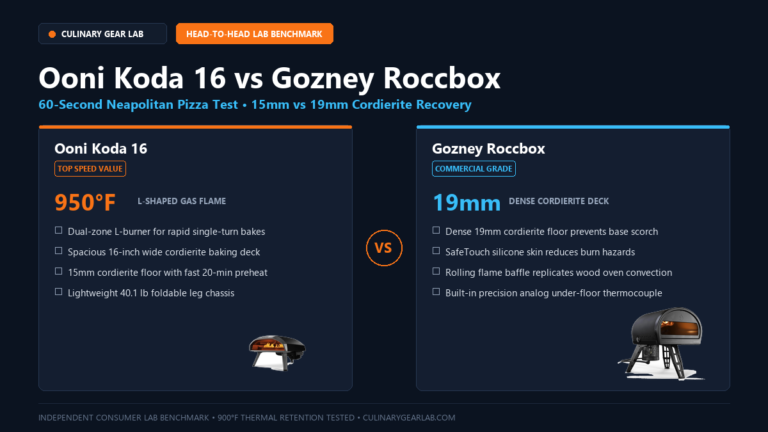
- Thermal Retention Advantage: The biggest benefit of the door is not just visibility—it is thermal equilibrium. Open-mouth ovens like the Ooni Koda 16 or Gozney Roccbox bleed heat continuously out of their 18-inch front maw. The Karu 12G’s sealed door keeps convection heat locked directly inside the ceiling dome, dramatically speeding up ceiling heat reflection back onto the top toppings.
4. Gas vs. Wood Performance: The 60-Second Smoke Flavor Myth
Here is the dirty secret of the wood-fired pizza oven industry: you cannot heavily smoke a pizza in 60 seconds.
In barbecue smoking—whether cooking brisket or pork ribs—wood smoke particulates (syringol and guaiacol compounds) require hours to permeate raw myoglobin proteins and cold, moist meat tissues to form a smoke ring and deep phenolic flavor. In a Neapolitan pizza oven running at 900°F:
- The draft speed through the chimney flue is moving at extreme velocity (several meters per second). Smoke does not linger; it is aggressively drafted out the stack.
- The pizza only resides inside the chamber for 60 to 90 seconds total.
- At 850°F+, the fire is burning in high-efficiency secondary combustion, which produces clean blue heat and very little visible white smoke.
The Blind Taste Test Results: We baked identical 65% hydration dough balls topped with San Marzano tomatoes, fresh low-moisture mozzarella, and basil—half cooked over kiln-dried white oak splits and half cooked with the Ooni Gas Burner. In a blind tasting with four testers:
- Three out of four testers could not reliably tell which crust was baked with wood versus gas.
- What people perceive as “wood-fired flavor” is almost entirely Maillard reaction charring—the localized blistered carbon spots (leopard spotting) created by the extreme 900°F stone contact and top-down convection flame roll.
- Where wood did make a sensory difference was in ambient aroma: eating pizza on a patio filled with fragrant oak campfire smoke tricks your olfactory system into expecting and perceiving a woodsy richness, even if the dough crumb itself absorbed virtually negligible smoke flavor.
5. Thermal Recovery Curves & Multi-Pie Party Pacing
The true test of any outdoor pizza oven is not how it bakes pie #1—it is how it handles pie #4 when you have a party of hungry guests waiting. When a room-temperature (or cool fermented) dough ball hits an 850°F cordierite stone, thermal conduction instantly sucks heat out of the stone deck into the moist dough.
We tracked the exact center stone temperature drop immediately upon removing Pizza #1, and measured the minutes required to recover back to 850°F:
Why the Gozney Roccbox Recovers Faster: Notice that the Gozney Roccbox dropped only 85°F compared to 140°F on the Karu 12G. That is pure thermodynamics: the Roccbox features a massive 19mm dense cordierite stone deck surrounded by a heavy insulated jacket (totaling 44 lbs of thermal mass), whereas the Karu 12G uses a 15mm stone and prioritizes portability at 26.4 lbs. If you want maximum recovery speed for baking 10 consecutive pies, the heavier stone wins; if you want an oven you can pack into the trunk of a sedan for a weekend camping trip, the Karu 12G’s 4-minute recovery on gas is very respectable.
6. Ergonomics & The 12-Inch Stone Reality Check
One critical aspect many first-time buyers underestimate is maneuvering clearance. The Karu 12G’s baking stone measures 13.2 inches wide. If you stretch a classic 12-inch dough skin, you have approximately 0.6 inches of clearance on each side.
Here is what that means in practice:
- Peel Precision: If you use a wide rectangular peel, launching into the 12G requires straight-line surgical precision. If your launch angle is off by 5 degrees, your crust edge will scrape against the internal side walls or brush against the rear firebox flame guard, causing raw cheese and toppings to slide onto the hot stone.
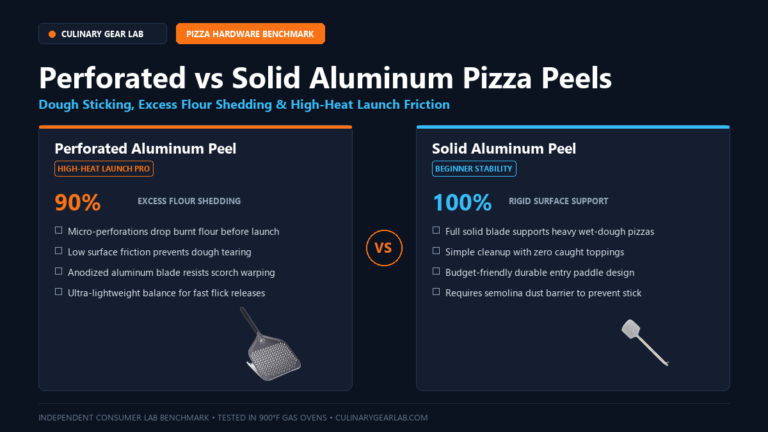
- Turning Technique: You cannot easily rotate a pizza inside the Karu 12G using a standard 12-inch launching peel. You have two options: either pull the pie completely out onto the peel, manually rotate it 90 degrees with your fingers or tongs, and reload it; or invest in an 8-inch round turning peel that can maneuver inside the tight chamber. (Check our guide to Perforated vs Solid Pizza Peels for our recommended tool setups).
- The 16-Inch Alternative: If you regularly make 14-inch to 16-inch New York-style or party pies, the 12G will feel frustratingly cramped. In that case, jump straight to the larger Ooni Koda 16 or Karu 16.
7. Head-to-Head Comparison: Ooni Karu 12G vs. The Top Competitors
To see how the Ooni Karu 12G stacks up against the broader outdoor oven landscape, we compared it against the three dominant 12-inch class contenders: the dual-fuel tank Gozney Roccbox, the gas-only lightweight Ooni Koda 12, and the budget-friendly Solo Stove Pi Prime.
8. The Accessory Math: What Does the Karu 12G Really Cost?
Before you click buy, you must understand the complete financial commitment. Unlike the Gozney Roccbox—which ships with a high-end commercial pizza peel included in the box—the Ooni Karu 12G box contains only the oven, chimney, fuel tray, and cordierite stone.
Marcus’s Real-World Cart Calculator
If you want the dual-fuel convenience Ooni advertises, you will need to add the Ooni Karu 12 Gas Burner ($119.99), a quality 12-inch perforated launch peel (~$45), an infrared thermometer gun (~$35), and an all-weather waterproof cover (~$40). That puts your true all-in investment right at $660 to $680.
Is it worth that $650+ investment? If you genuinely use both fuel sources—firing up wood on relaxed Saturday afternoons with family, and clicking into gas when hosting a Friday night crowd of 10 people—the Karu 12G delivers two completely distinct outdoor cooking experiences inside one compact, 26-pound chassis. But if you know in your heart that you will never gather kindling, chop mini hardwood splits, or clean ash grates, save your money and buy a dedicated gas oven like the Ooni Koda 16 or Solo Stove Pi Prime.
9. Long-Term Maintenance: Pyrolytic Cleaning & Soot Removal
Maintaining a multi-fuel oven requires very specific procedures to prevent cracking your cordierite stone:
- Never Use Soap or Water on the Stone: Cordierite is extremely porous. If it absorbs water and you heat it to 800°F during the next session, the trapped steam will expand explosively and fracture the stone.
- The Pyrolytic Burn-Off Trick: If melted cheese or burnt semolina flour scorches onto the stone deck, simply remove the pizza, put the door on, and crank the fire (or gas burner) to max blast for 15 to 20 minutes. The intense 950°F heat will reduce all carbonized organic debris into fine grey ash. Once the oven cools completely, sweep it out with a dry brass wire brush.
- Cleaning the Glass Door: For light soot, wait until the oven cools to room temperature and wipe the inside pane with a dry paper towel. For stubborn creosote buildup, dip a damp paper towel into clean wood ash from the rear fuel tray and gently rub the glass; the alkaline ash acts as a natural, zero-scratch abrasive that cuts through carbon deposits like magic.
10. The Final CGL Verdict: Who Should Buy the Ooni Karu 12G?
Marcus Vance’s Independent Bottom Line
The Ooni Karu 12G is without question the most refined compact portable pizza oven Ooni has ever produced. The ClearView glass door is not a marketing trick—it fundamentally improves internal thermal retention and lets you monitor high-heat baking without dumping heat. Its 15mm cordierite deck holds enough thermal mass for consistent bakes, and the modular chassis transitions between wood fire and propane gas in under two minutes.
While it doesn’t match the heavy-duty 44 lb thermal mass of the Gozney Roccbox, it beats the Roccbox decisively on portability and true solid-fuel ergonomics. If you want a masterclass in backyard artisanal pizza making and refuse to be locked into a single fuel source, the Ooni Karu 12G earns our highest multi-fuel recommendation.
Frequently Asked Questions (People Also Ask)
Does the Ooni Karu 12G come with the gas burner in the box?
No. The Ooni Karu 12G is shipped as a solid-fuel oven equipped to burn kiln-dried hardwood chunks and lump charcoal out of the box. To run the oven on propane gas, you must purchase the optional Ooni Karu 12 Gas Burner attachment separately, which mounts to the rear with two thumb screws.
Can you bake with wood pellets in the Ooni Karu 12G?
No. The Karu 12G fuel grate is engineered specifically for hardwood kindling splits (up to 5 inches / 12 cm long) and natural lump charcoal. Wood pellets will fall through the perforated grate slots or choke the airflow, resulting in smothered combustion. For pellet-specific baking, look at the Ooni Fyra 12.
How do you keep the ClearView glass door from getting black soot?
To minimize soot on the glass door, always burn fully dried hardwood with a moisture content under 15% (kiln-dried oak, beech, or ash), keep the chimney baffle damper completely open during heating, and establish a hot lump charcoal ember bed before feeding wood chunks. Once the oven hits 750°F+, radiant heat will burn away light soot films automatically.
Can the Ooni Karu 12G be used indoors?
Absolutely not. The Karu 12G produces intense open flames, carbon monoxide, and exhaust heat, whether burning wood, charcoal, or propane. It is strictly rated for outdoor use in well-ventilated spaces with at least 3 feet of clearance from walls and overhead combustibles. If you need an indoor pizza oven, see our guide to the Breville Pizzaiolo and Ooni Volt 12.
How long does a 20 lb propane tank last on the Ooni Karu 12G?
The Ooni Karu 12 Gas Burner consumes approximately 1.1 lbs (0.5 kg) of propane gas per hour of continuous high-output operation. A standard 20 lb barbecue propane tank will provide approximately 18 to 20 hours of continuous baking time, equating to dozens of pizza sessions.
Is the Ooni Karu 12G big enough for 14-inch or 16-inch pizzas?
No. The internal cordierite stone measures 13.2 x 13.2 inches, and the front door opening width is 13.3 inches. It is strictly limited to 12-inch personal Neapolitan pizzas. For larger 14-inch to 16-inch pizzas, you must step up to the Ooni Karu 16 or Ooni Koda 16.